

As the automotive sector continues its transition towards electrification, digitalisation and sustainable mobility, vocational education providers face a growing challenge: how can learners develop a deep understanding of increasingly complex vehicle systems while maintaining the hands-on nature of vocational training?
Within the DigiGEAR project, this question guided the development of an innovative training methodology that combines traditional vocational education with Augmented Reality (AR)-based learning experiences. Rather than introducing technology for its own sake, DigiGEAR adopts AR as a pedagogical tool designed to support understanding, reinforce learning outcomes and complement practical automotive training.
The development of the DigiGEAR training approach builds directly on the needs identified during the project’s research phase. As emerging automotive technologies require new competences in areas such as electric mobility, batteries, power electronics and digital systems, the consortium sought to create learning resources that would help learners understand not only individual components but also how these elements function together within a complete electric vehicle ecosystem.
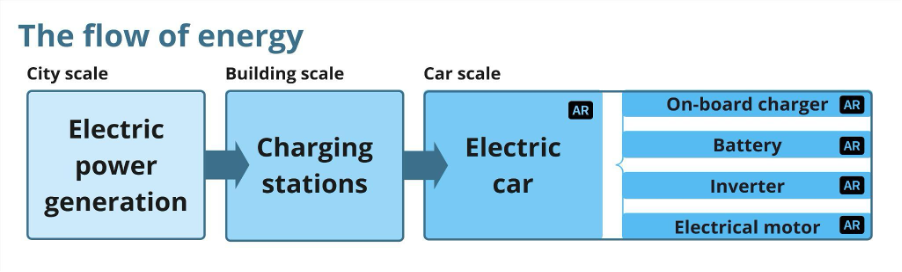
One of the distinctive features of the DigiGEAR methodology is its “Flow of Energy” narrative. Instead of studying electric vehicle technologies as isolated topics, learners follow the journey of energy through the entire electric mobility ecosystem. The learning pathway begins with energy generation and sustainability concepts, continues through charging infrastructure, and then explores the main components inside an electric vehicle, including the onboard charger, inverter, battery and electric motor. This approach helps learners understand how energy is generated, transferred, stored, converted and ultimately transformed into vehicle motion.
To support this learning journey, DigiGEAR developed a structured training package consisting of ten interconnected modules. These modules cover topics including electric vehicle fundamentals, charging technologies, onboard charging systems, inverter systems, battery systems, electric motors, regenerative charging, green energy and sustainability. Together, they provide learners with both technical knowledge and a broader understanding of the role electric vehicles play within future mobility systems.
The pedagogical design of DigiGEAR follows a simple but important principle: AR activities are intended to reinforce learning, not replace it. Learners are encouraged to first complete the corresponding learning module through the Moodle platform and then engage with the AR activities designed to consolidate and apply their knowledge. Reflection activities are integrated afterwards to help learners connect theoretical concepts with practical applications and real-world examples.
This educational sequence is reflected in the design of the DigiGEAR AR application. The platform combines introductory lessons delivered through interactive 2D activities with immersive 3D AR experiences focused on the core components of electric vehicles. While introductory topics such as energy generation and charging infrastructure are explored through 2D interactions, the internal systems of electric vehicles are presented through three-dimensional models that learners can position, manipulate and investigate within their physical environment.
The most comprehensive AR lesson focuses on the complete electric vehicle system and introduces learners to four progressive learning scenarios: Explore, Identify, Place and Connect. Through these activities, learners first investigate vehicle components freely, then recognise them based on their appearance, position them correctly within the vehicle structure and finally connect them according to the correct flow of electrical energy. Through these progressive activities, learners not only recognise components but also practise positioning and connecting them within the electric vehicle architecture, reinforcing spatial understanding, system thinking and the interpretation of energy transfer processes before interacting with real equipment. This sequence transforms learners from passive recipients of information into active participants in the learning process.
Additional AR scenarios focus on specific vehicle components. Learners can explore detailed three-dimensional models of batteries, inverters, motors and onboard chargers, identifying key internal elements and understanding their functions. These activities expose learners to components and subsystems that are often difficult to access or observe directly in traditional training environments, such as Battery Management Systems (BMS), key onboard charger elements and inverter components involved in power conversion processes. By visualising these structures in a safe and interactive environment, AR helps make complex technical concepts more accessible while supporting procedural reasoning and a deeper understanding of energy flow within electric vehicles.
The DigiGEAR methodology also reflects broader educational principles described in the project’s Facilitators Handbook. The approach promotes active participation, learner-centred education, project-based learning and collaborative activities. Trainers are encouraged to guide learners through problem-solving tasks, stimulate discussion and support reflection, ensuring that digital tools contribute meaningfully to the overall learning experience.
Importantly, the project recognises that vocational education remains fundamentally practical. AR is therefore positioned as a complementary resource that can help overcome challenges such as limited access to specialised equipment, restricted availability of electric vehicle components or safety considerations associated with high-voltage systems. By allowing learners to visualise, manipulate and explore technologies in a safe and interactive environment, DigiGEAR expands learning opportunities while preserving the essential value of hands-on training.
Ultimately, the DigiGEAR approach demonstrates that innovation in vocational education is most effective when technology is guided by pedagogy. By combining structured learning modules, interactive AR scenarios and learner-centred educational strategies, the project is creating a training model that helps prepare learners for the technological realities of electric mobility and sustainable transport.